

Every replacement part promises it will fit, work, and last about as long as the part it replaced. Parts made by the appliance manufacturer are designed and tested to keep all three. Many cheaper alternatives keep only the first, and sometimes not even that.
The difference rarely shows up on the day of the repair. The washer drains again, the oven heats, the fridge starts cooling, and the lower price feels like a smart call. The problems tend to surface weeks or months later, as a slow leak under the cabinet, a sensor that reads a few degrees off, or a fuse that blows for no obvious reason. By then, few people connect the new problem to the part that was installed to fix the old one.
For homeowners comparing quotes for appliance repair in Vancouver, the choice between original and aftermarket parts often isn’t mentioned at all. It’s simply buried in the price. Here we cover what separates the different types of parts, where the savings on cheaper ones really come from, and how a part that saves $100 at the counter can end up costing several times that once you add the second service call.
OEM, Aftermarket and Counterfeit: What They Mean
These words get used loosely, and the differences matter.
- OEM (original equipment manufacturer) parts are made by the appliance brand or by the supplier that built the original component to the brand’s specifications. They’re the same parts your appliance came with from the factory.
- Aftermarket parts are made by third-party companies to fit your appliance. Some are well engineered and properly tested. Others are reverse-engineered copies made as cheaply as possible.
- Counterfeit parts are aftermarket parts dressed up to look genuine, with copied logos, fake part numbers, and packaging designed to pass as the real thing. These are the riskiest of the three, because you don’t even know what you’re buying.
The trouble is that online listings rarely make these categories obvious. A product title that includes a brand name and a part number can be any of the three.
Why Aftermarket Parts Cost Less
The price gap isn’t magic. The money is saved somewhere, and usually in one or more of these places:
- Materials: Cheaper plastics, thinner copper windings, lower-grade rubber seals, and less durable bearings.
- Tolerances: Parts made to looser dimensions that fit well enough to install but not well enough to seal, align, or run quietly for years.
- Testing: Little or no endurance testing under real heat, vibration, and moisture.
- Engineering: No design work of their own. A copied part reproduces how the original looks, not necessarily how it performs.
- Certification: Electrical and safety certification may be missing, or claimed without being earned.
None of this shows up on day one. A part with looser tolerances still bolts in, and a thermostat calibrated a few degrees off still switches. The cost shows up later, in how long the part lasts and what it does to everything around it.
How a Cheap Part Turns Into a Second Call
Aftermarket failures tend to follow a few recognizable patterns.
Poor fit causes slow damage
A drain pump, door boot, or gasket that’s a fraction of a millimeter off can seep for months before anyone notices. Water dripping under a washer or dishwasher often doesn’t show until it has damaged the subfloor or the cabinet base. In a condo, it can reach the unit below. A leaking door gasket is one of the most common reasons for dishwasher repair, and a poor-fitting replacement can bring the same leak back.
Wrong specs strain the rest of the appliance
Electrical parts work as a system. A dryer’s cycling thermostat, high-limit thermostat, and thermal fuse are matched to each other and to the heating element. Swap in a thermostat that opens at a slightly different temperature, and the element can run hotter or cycle more often than intended, which wears out other parts faster. This is why dryer repair done with mismatched thermostats often ends with a blown fuse a few weeks later.
Sensors that read slightly wrong
Newer refrigerators rely on thermistors, sensors whose electrical resistance changes with temperature in a precise, model-specific way. An aftermarket sensor with a slightly different curve can make the control board think the freezer is colder or warmer than it is. You get frost buildup, defrost cycles at the wrong time, or a fresh food section that drifts warm. These faults are hard to diagnose because nothing looks broken. They’re common reasons people end up needing refrigerator repair again soon after a “successful” fix.
Control boards that don’t match the software
Electronic control boards are the most expensive parts in many modern appliances, so they’re a frequent target for cheap alternatives, including used and refurbished boards sold online. A board can share a part number and still run a different firmware revision than your machine expects. The result can be error codes, features that don’t work, or a machine that runs fine for a week and then stops responding.
Gas components where “close enough” isn’t acceptable
On a gas oven, the igniter has to draw a specific current to open the gas valve. A weak igniter can glow without drawing enough current to open the valve properly. That shows up as an oven that takes forever to heat or doesn’t light at all, and it can also mean gas flowing before ignition happens. For oven repair, stove repair, and cooktop repair on gas units, part quality is a safety question as much as a cost question.
The Real Math of a Second Service Call
People often do not even know what part is being used; they trust the appliance repair technician. It is always necessary to have the conversation upfront about the parts which are going to be used. We use OEM parts only and always aim to deliver the highest quality service to our customers.
Take a simple example. Say an OEM part costs $240 and the aftermarket version costs $100, so on paper that’s $140 saved. If the cheap part fails within two years, the second round typically involves:
- Cost of another diagnostic visit
- Cost of the OEM part you’re now buying anyway
- Any damage the failed part caused, such as a warped subfloor, a ruined load of laundry, or a fridge full of spoiled food
- Labor to remove the failed part and install a new one
- The time you spend waiting at home, again
Against all that, the original $140 saving disappears quickly.
The Warranty Problem Nobody Mentions
There are two warranties to think about with any repair: the manufacturer’s warranty on the appliance, and the repair company’s warranty on its work.
Manufacturer warranties are often explicit about this. Whirlpool’s Canadian limited warranty documents, for example, list damage caused by non-genuine Whirlpool parts among the things the warranty doesn’t cover. Some newer versions add that using third-party parts doesn’t void the warranty outright. Either way, if a non-genuine part causes damage, the cost of fixing that damage falls on you. If your appliance is still under warranty, that alone is a reason to stick with OEM.
Repair company warranties work in a similar way. Many repair businesses will only stand behind repairs made with parts they source and trust. If you supply your own part or ask for the cheapest option available, it’s worth asking what the warranty covers before the work starts.
Refrigerator Water Filters: A Case Study in Hidden Risk
Water filters are the most widely bought appliance replacement part, and the clearest example of how bad cheap substitutes can be.
The Association of Home Appliance Manufacturers had independent labs test counterfeit refrigerator filters against the same standards genuine filters are certified to. The results were alarming:
- Only 2 of 18 counterfeit filters labeled as lead-reducing actually removed lead over the full six-month filter life.
- In a separate test, 8 of 14 filters failed before reaching even half of their typical lifespan.
- Some counterfeits added contaminants to clean water, including substances such as arsenic.
AHAM also warns that counterfeit filters can fit poorly and leak, which risks damage to your floors and cabinets.
The worrying part is that you can’t tell any of this by tasting the water. A counterfeit filter can look identical to the real one and feel fine to install. If you buy filters online, buy from the manufacturer or an authorized retailer, and be suspicious of prices far below the usual cost.
Recalls Happen to Replacement Parts Too
Cheap replacement parts sold online don’t always meet the safety standards people assume they do.
Health Canada recently recalled an aftermarket oven bottom panel sold through Amazon.ca after finding that its coating could decompose rapidly under heat, crack, peel, and give off dense smoke inside the oven. The product was sold as a simple replacement part, the sort of thing many homeowners would order without a second thought.
That’s an extreme case, but it shows the general point. A part that goes inside an appliance that gets hot, holds water, or runs on gas needs to be designed and tested for those conditions.
When Aftermarket Parts Are a Reasonable Choice
To be fair, not every non-original part is a mistake. Aftermarket parts can be sensible in some situations:
- Purely cosmetic or simple mechanical parts: Knobs, shelf bins, dishwasher racks, light bulbs, and some handles carry no electrical load and little stress.
- Discontinued models: When the manufacturer no longer makes a part for an older appliance, a quality aftermarket version may be the only way to keep it running.
- Reputable aftermarket brands: Some third-party manufacturers engineer and test their parts properly. The issue is that buyers usually can’t tell which ones those are from a listing.
- Short-term fixes on an appliance that’s near the end anyway: If a fridge is 16 years old and you plan to replace it next spring, a cheap part to bridge the gap can be a reasonable call, as long as it doesn’t involve gas or safety components.
The higher the load on the part, through heat, water pressure, electrical current, or gas, the stronger the case for OEM.
How to Tell What You’re Actually Getting
If you’re buying a part yourself, or reviewing a technician’s quote, these checks help:
- Ask directly. “Is this OEM or aftermarket?” is a fair question, and a reputable technician should answer it plainly.
- Match the full part number to your appliance’s model and serial number, not just the brand and appliance type.
- Be wary of prices that seem too good. Genuine parts rarely sell for a fraction of the manufacturer’s price.
- Look at the seller, not just the reviews. Marketplace listings change sellers and suppliers often, so reviews may be for a different product than the one you receive.
- Check the packaging and weight. Counterfeits are often lighter than genuine parts and come in packaging with blurry printing, spelling errors or missing certification marks.
- Look for certification marks on electrical components, such as CSA. Their absence is a warning sign.
What About Bringing Your Own Part?
Some homeowners order a part online and ask a technician to install it, which seems sensible on the surface: you save on the part and pay only for labor.
In practice, it often causes problems:
- If the part is wrong or defective, the visit becomes a diagnosis with nothing to install, and you pay for a second trip anyway.
- If the part was the wrong diagnosis in the first place, you’ve bought something you didn’t need.
- If the part fails later, it’s unclear who’s responsible, and the installer usually won’t warranty a part they didn’t source.
Many appliance repair companies handle customer-supplied parts differently for exactly these reasons. When in doubt, have the appliance diagnosed first, then decide on parts once you know what failed.
Why We Only Install OEM Parts at Barton
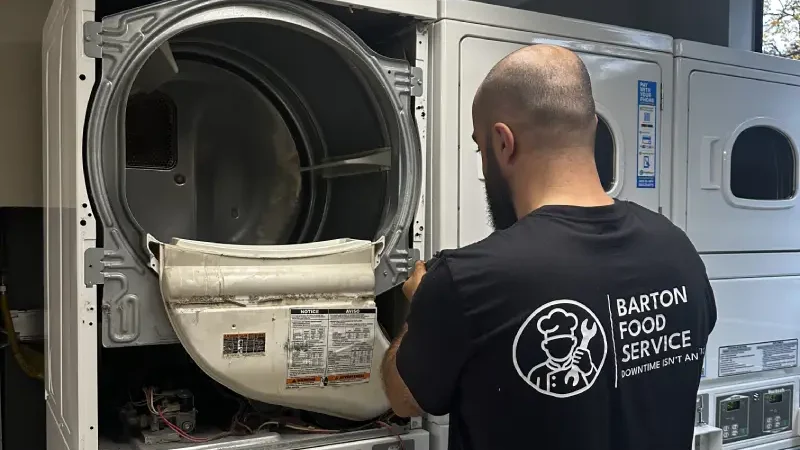
We decided early on to use genuine manufacturer parts on every repair, and it’s one of the main reasons customers call us back. Yes, OEM parts sometimes cost a little more up front. But we’d rather install the right part once than send a technician back in three months to replace a cheap one, and our customers would rather avoid that too.
Every repair comes with a parts and labor warranty, and if the same problem returns, we come back at no extra charge. We can only offer that because we trust the parts we install. Our technicians work on everything from Samsung and LG laundry pairs to Sub-Zero and Wolf kitchens, and the $100 diagnostic fee is credited toward your repair if you go ahead. If you’d like a straight answer on what’s wrong and what the fix will cost, call us at (778) 653-6929.